What Is a Lease Audit?

Hayley Annichiarico
Marketing Manager
Key takeaways
- A lease audit compares signed lease documents against your property management system records to find billing discrepancies.
- The most common findings are missed fees: pet fees, parking fees, and concessions that expired but were never removed from the ledger.
- Manual audits are slow and usually cover only a sample of files. Most portfolios have more errors than a spot-check will catch.
- Automated lease auditing reviews every file continuously, not just when someone schedules a project.
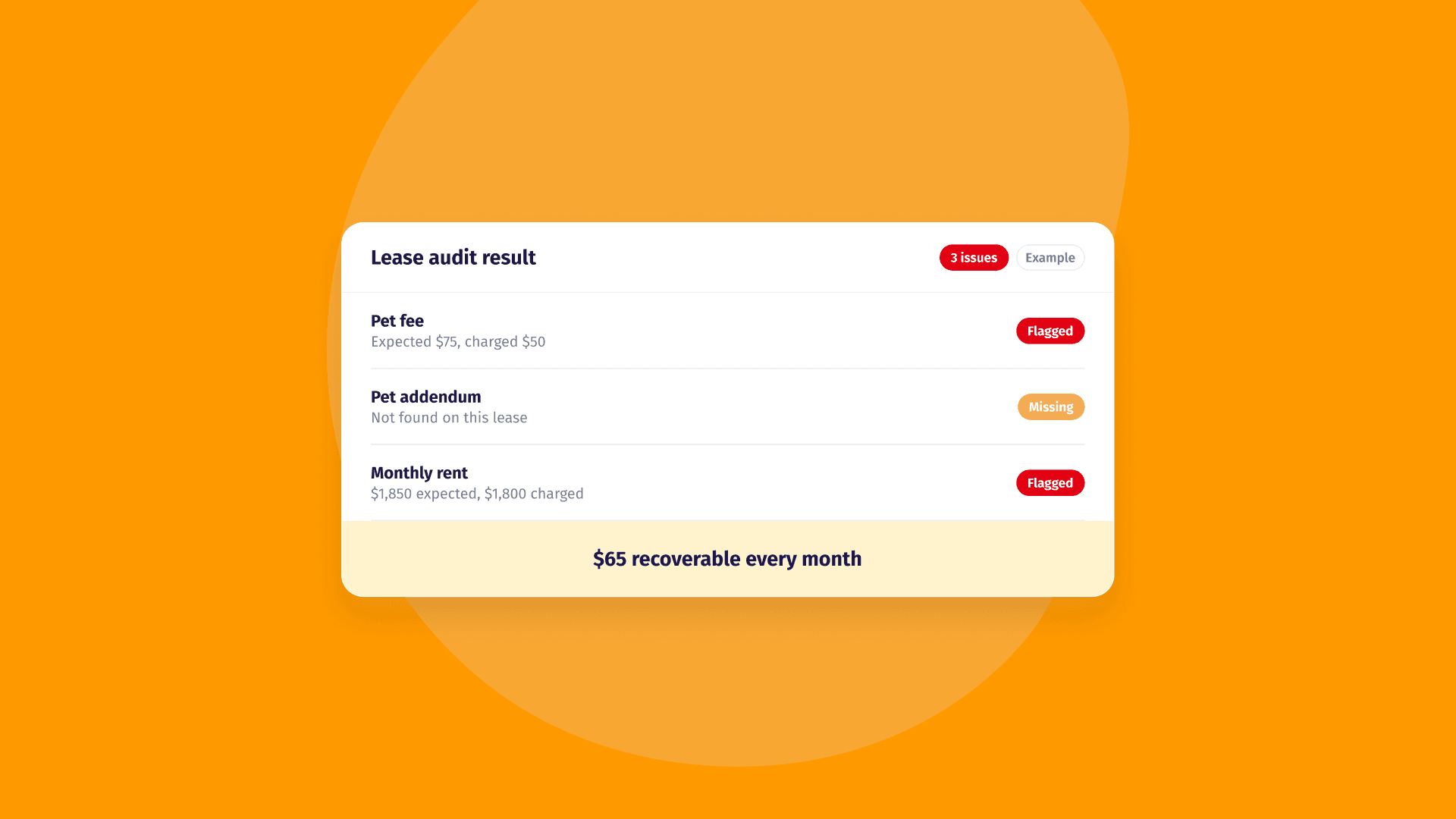
A lease audit is a structured review of your signed lease documents against your property management system records, including your rent roll. The goal is to confirm that each lease requirement is accurately reflected in the signed lease: rent amounts, fees, concessions, deposits, and required signatures.
For multifamily operators, it's a necessary step to find missed charges and billing errors, especially during due diligence.
What a Lease Audit Checks
A lease audit reviews your signed leases against your rent roll and default lease expectations you have for standardized fields. This includes:
- Rent amount, compared against what the ledger shows
- Pet fees, parking fees, storage fees, and amenity charges
- Security deposit amount and whether it was collected
- Concessions, including whether they were applied correctly and whether they expired on time
- Required signatures on all pages, addenda, and renewals
- Lease term, start date, and expiration date
- Authorized occupants and pets
- Required addenda, which can vary by state
These fields are commonly incorrect, though rarely intentionally. Most errors come from missed steps during lease-up, data entry issues, or details that weren't updated after signing.
The Impact on Revenue
With lease audits, the most common finding is missed fees. We've seen pets on the lease but never entered in the system; parking spots included in the agreement but never billed; concessions that ended in month two but are still showing as a credit in month eight.
Across a 200-unit portfolio, a $50 missed pet fee in 10% of units is $1,000 a month. That's $12,000 a year from one missed charge type. Add parking, storage, and unremoved concessions, and the number grows quickly across a full portfolio.
Another big area to audit is compliance. Missing signatures, unsigned addenda, and unreported occupants don't carry an immediate dollar cost. Still, they create risk that's harder to clean up later than if you found the issue right after signing.
A lease audit catches both financial and compliance issues before signing, or during a bulk property audit.
When Is the Best Time to Run a Lease Audit?
It's never a bad time to run a lease audit, but acquisitions are the most common trigger. Before closing, buyers need to verify that the rent roll reflects what's actually in the lease files. Discrepancies found during due diligence can be addressed before the deal is completed. After closing, files inherited from a previous management company can have gaps from different systems, processes, and documentation standards. Completing an audit can ensure you start with a clean baseline free of compliance risks.
Ongoing reviews are just as useful. High unit turnover means a constant flow of new leases, renewals, and move-in documentation. Each one is a chance for a step to get missed. Regular audits keep small errors from compounding across the property or portfolio.
A single billing discrepancy is also a signal for your whole property. If one unit has an error, others likely do too. A full property audit, not just the flagged unit, is the more reliable response.
Manual Auditing vs. Automated Auditing
A manual audit involves pulling reports from your property management system, comparing them against lease documents, and logging discrepancies. At a small portfolio size, it's doable, but time-consuming. As a portfolio grows, it becomes impossible to reliably conduct a manual audit without outsourcing, which is costly and can take days or weeks for a single property.
Automated auditing is faster and significantly less expensive. Software like Pivott can connect directly to your property management system and lease creation software to compare lease documents against resident ledger data, and flag discrepancies across every unit in the property. A full-property review that would take an outside firm days or weeks runs in hours.
Getting Started with Lease Audits
Lease audits aren't complicated. You're checking that what's in the lease matches what's in your system. Most of the time, it doesn't match exactly, and that gap costs money.
Running audits regularly keeps you ahead of it. Whether you do it manually or use a tool like Pivott to automate the process, the goal is the same: know what your leases say and make sure your billing and records reflect it.
Ready to Recover Revenue?
See how Pivott's Lease Auditor catches missed fees and billing errors across your portfolio.
Ready to automate?
See how Pivott helps multifamily teams manage contracts, compliance, and vendor documents in one place.
Book a Demo