Tracking Payments from Revenue Contracts

Adam Cowley
CEO

Key takeaways
- Ad hoc tracking is just another phrase for 'not managed' — it's not a strategy for collecting the revenue you're owed.
- Accounting teams can't know the intricacies of every contract, making it impossible for them to identify missed payments on their own.
- Contract management is the only approach that sets clear expectations, tracks income against those expectations, and ties everything back to the signed agreement.
- Payments need to be allocated on an accrual basis — not by cash deposit date — to accurately identify what's missing.
One day soon, you'll get an email from your boss that reads: "Are all of our revenue partners paying us what we expect? Are they paying on time?" You could spend weeks scrambling to piece together an answer — or you can get ahead of it now. Here's how.
Generating ancillary revenue in multifamily isn't new. Parking lots and coin-op laundry have existed for decades. What's new is the growing list of options: storage units, utilities, whole-building WiFi, recycling programs, valet services, bike storage, pet rent, and several options tied to electric vehicles, to name a few.
Researching and negotiating those contracts may feel like the bulk of the work — but who's watching to make sure you actually get paid? Without a strategy for auditing revenue, all of that effort could amount to nothing.
Where to start
Some revenue contracts have fixed income — like renting roof space to a telecom provider. Many others are variable, depending on what residents purchase each month. Both types require auditing, but the former is simpler.
There are three common approaches teams use:
- Ad hoc — check from time to time but trust that vendors are paying you.
- Accounting — log it as expected revenue in your budget and check financial statements to find gaps after the fact.
- Contract management — list all expected revenue sources and tie them directly to the properties and signed contracts they belong to.
The problem with ad hoc tracking
Ad hoc is just another way of saying "not managed." And expecting your accounting team to know the intricacies of every revenue contract you've signed is unreasonable.
Even if accountants had the time to create outbound invoices for every expected revenue source, they often can't know what those amounts will be — which makes it impossible to balance debits and credits. Most accountants won't attempt it. The result is a gap between what you expect and what you can actually see.
The solution: contract management
Contract management is the only approach that fully closes the loop. We should collect revenue from vendor partners with the same discipline used to collect rent from residents. Imagine how difficult rent management would be if payment amounts varied based on how much time each resident spent at home. That's exactly the complexity we face with variable revenue contracts — and it deserves a proper system.
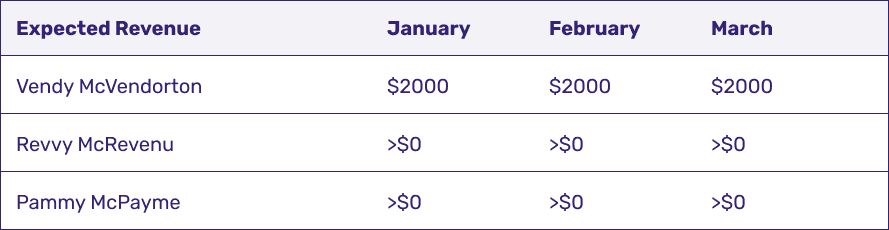
Step 1: Set expectations. For every revenue contract, record either the exact expected amount or a clearly defined placeholder. Here's a simple example:
Step 2: Import payment records. Pull actual payment data from your accounting department — typically a general ledger export.
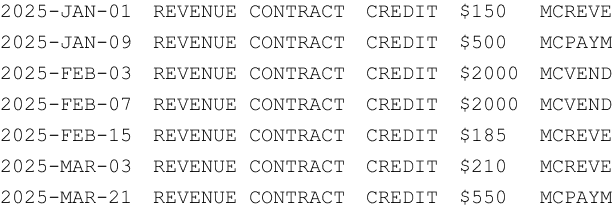
Format that data into a table for readability. But it doesn't take long to see the problem — you can see that Pammy paid in March, but there's no way to tell if that payment applied to February.
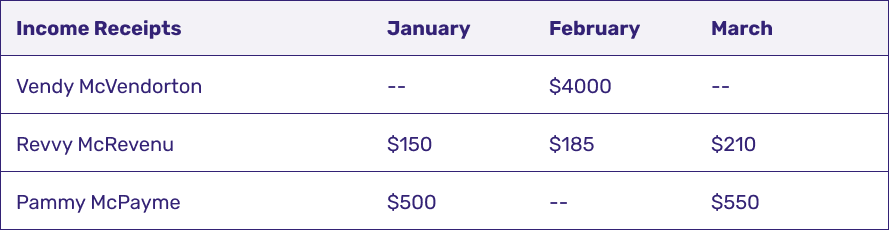
Step 3: Compare expected payments against actual income. This is where most existing processes fall short.
Vendy McVendorton — Say today is April 1st. Which months does the $4,000 payment apply to? Is it for January and February with March still pending? Or was January missed and they overpaid for February? Without matching income to expectations, you can't know.
Revvy McRevenu — It may look fine to see a payment every month, but is it the right amount? You need a trend line and comparisons across properties to gauge what's actually typical.
Pammy McPayme — At first glance it looks like February was missed, but maybe accounting deposited the payment in March. Payments need to be allocated on the accrual method — not the cash method — to accurately identify what's missing.
Conclusion
With the growing number of ancillary revenue opportunities available, tracking payments accurately isn't optional — it's a core part of managing a multifamily portfolio. Ad hoc approaches and accounting-only visibility leave too much room for missed payments and errors.
Contract management gives you a system to set clear expectations, track income against those expectations, and tie every payment back to the contract that governs it. When your boss asks whether all your revenue partners are paying on time, you'll have the answer ready.
Ready to automate?
See how Pivott helps multifamily teams manage contracts, compliance, and vendor documents in one place.
Book a Demo